
HOME LAB
Home Lab Architecture
A dedicated, current visual reference for the physical infrastructure, shared services, nested VMware Cloud Foundation environments, physical VCF 9.1.1 domains, networking, storage, and the ROBO1 remote-site lab behind an Ubuntu WAN simulator.
October 22 workload and Private AI update
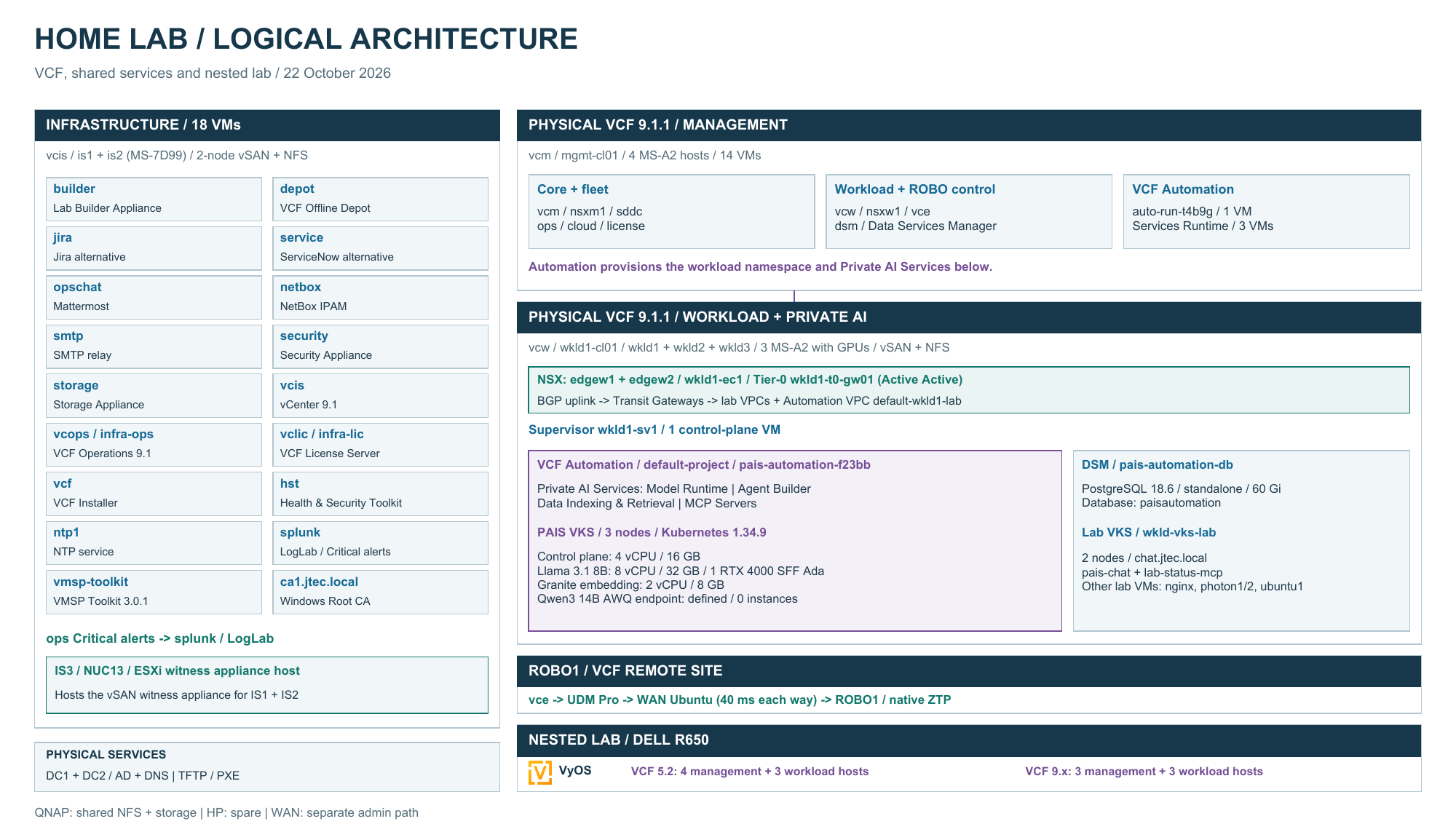
All three MS-A2 workload hosts remain in wkld1-cl01. NSX uses edgew1 and edgew2 in wkld1-ec1, with the Active Active Tier-0 gateway wkld1-t0-gw01, BGP, transit gateways, and VPC connectivity. Automation uses the default-wkld1-lab VPC.
VCF Automation manages Private AI Services in default-project / pais-automation-f23bb on Supervisor wkld1-sv1. Its three-node VKS cluster runs a GPU-backed Llama 3.1 8B endpoint and a Granite embedding endpoint. The Qwen3 14B AWQ endpoint is defined with zero instances. The Llama worker uses an NVIDIA RTX 4000 SFF Ada Generation GPU.
Private AI includes Model Runtime, Agent Builder, Data Indexing and Retrieval, and MCP Servers. A standalone DSM PostgreSQL 18.6 database, pais-automation-db, provides persistence. The separate two-node lab VKS cluster hosts chat.jtec.local, pais-chat, and lab-status-mcp. Both diagrams have been refreshed from read-only checks of vSphere, NSX, VCF Automation, DSM, and Kubernetes.
October 11 infrastructure update
The former CA1 Intel NUC13ANHi7 now runs is3.jteclocal as the primary ESXi host for the vSAN witness appliance serving the IS1 and IS2 two-node vSAN cluster. IS1 and IS2 also have NFS storage alongside vSAN. ca1.jtec.local is now a Windows Root CA virtual machine, bringing the diagram’s infrastructure inventory to 18 VMs.
October 9 live inventory update
The diagrams now reflect read-only checks of the infrastructure, management, workload, and ROBO vCenters. Infrastructure includes VMSP Toolkit 3.0.1 (vmsp-toolkit), Health and Security Toolkit, NTP, LogLab, VCF Installer, and the infrastructure license server alongside the existing services.
The two MS-7D99 hosts now report Core i9-14900K CPUs and no active memory tiering. The Dell and MS-A2 hosts have active NVMe memory tiers; physical RAM and ESXi-visible memory are shown separately. The management cluster now contains 14 VMs, including DSM, three Services Runtime VMs and one Automation VM. ROBO1 is connected to vce / ztp-cl01, with ESXi 9.1.1 and native Zero Touch Provisioning.
The workload cluster now hosts NSX Edges, a Supervisor, Private AI and lab VKS clusters, a DSM PostgreSQL database, and lab VMs. The prior ROBO audit showed no guest VMs. WAN delay remains the last-confirmed 40 ms per direction; it could not be rechecked during this audit. Physical cabling and non-ESXi hardware retain the latest confirmed inventory.
ROBO1 and the simulated WAN
Central lab / UDM Pro → WAN Ubuntu → ROBO1
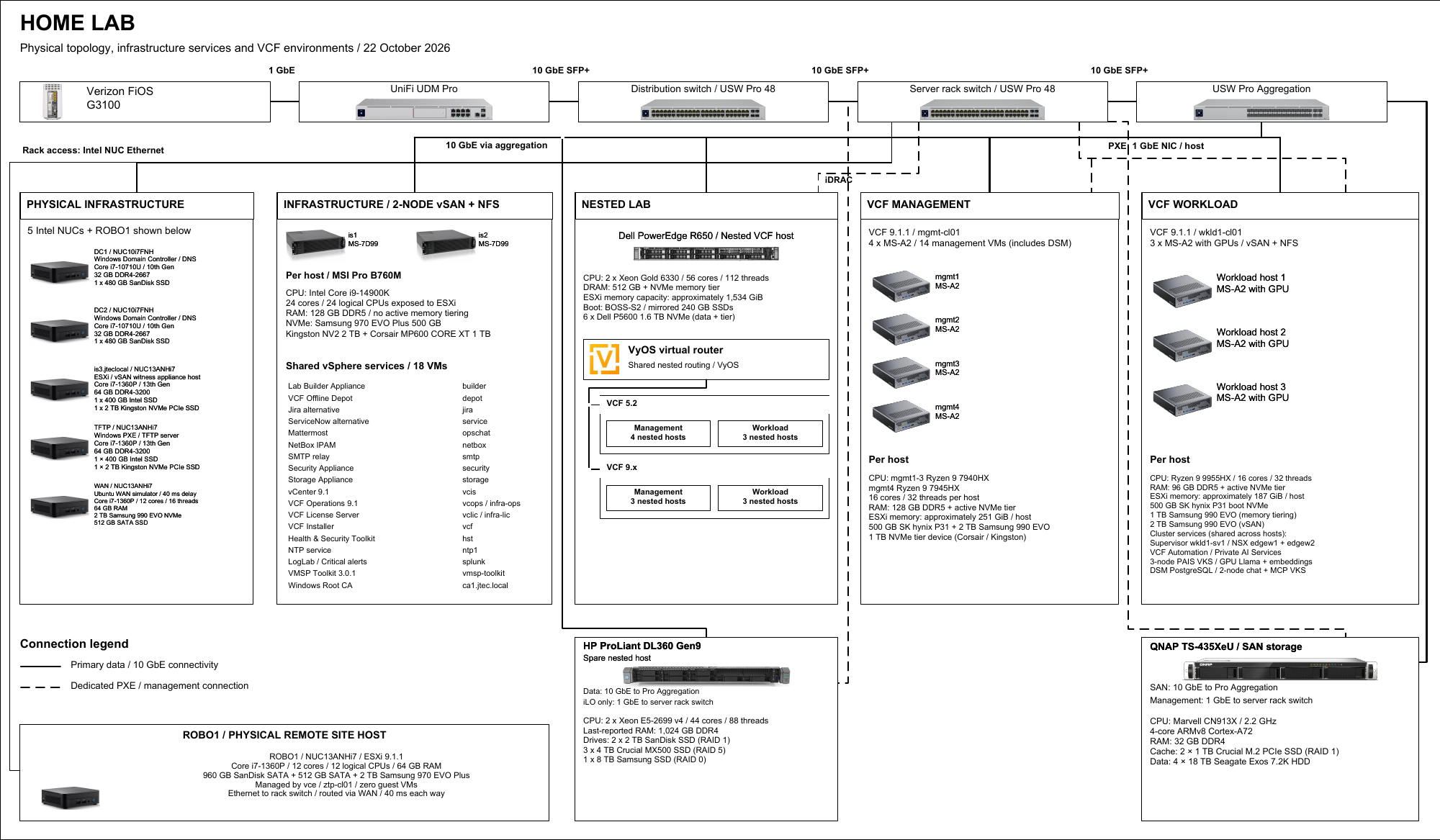
The Ubuntu WAN simulator and the Intel NUC13ANHi7 running ROBO1 ESXi each connect to the USW Pro 48 server-rack switch. The simulator uses a single 1 GbE physical port with tagged interfaces to route traffic to the remote site.
40 ms delay per direction adds approximately 80 ms to round-trip latency across the simulated WAN. Simulator administration bypasses the delay, and site-local traffic stays local. The three MS-A2 workload hosts remain in the central lab.
WAN Ubuntu replaces the former WinDepot role. Its NUC13ANHi7 has a Core i7-1360P (12 cores / 16 threads), 64 GB RAM, a Samsung 990 EVO 2 TB NVMe drive, and a 512 GB SATA SSD. The VCF Offline Depot Appliance remains in the infrastructure cluster.
The routed site networks include management, vMotion, host TEP, VNA management, and DTGW external connectivity. Overlay workloads use the selected NSX routing path.
NUC inventory: DC1 and DC2 use NUC10i7FNH systems. IS3, TFTP, WAN Ubuntu, and ROBO1 use NUC13ANHi7 systems. The former CA1 NUC now runs the is3.jteclocal ESXi witness appliance host for IS1 and IS2; ca1.jtec.local is a Windows Root CA virtual machine in Infrastructure. The former Backup NUC is now ROBO1; there is no separate physical Backup server.
PHYSICAL ARCHITECTURE
The complete lab at a glance
Updated October 22, 2026
Select the diagram to open the full-resolution image. The PDF provides the best option for zooming, printing, or keeping an offline copy.
VIRTUAL ARCHITECTURE
Virtual environments and shared services
Landscape reference
Explore 18 infrastructure VMs, 14 management VMs, the NSX-connected workload domain with Private AI Services, ROBO1, nested VCF environments.
COMPANION ARTICLE
Read the story behind the architecture
This page is the diagram-first reference. For the detailed narrative, hardware changes, design decisions, and comparison with the November 2025 environment, read the September 2026 architecture article, now updated with the October 6 WAN and ROBO1 changes.
Read the architecture update →Connection legend
Solid lines represent the primary data paths; link labels identify the connection speed. Dashed lines represent dedicated PXE, hardware-management, or other management connections.